ChatGPT sells ads now. The interesting part is where they sit.
OpenAI's Ads Manager is open to advertisers in Canada and Brazil. What it actually targets, who can see it, what we still can't tell you, and the test we'd run before moving a dollar.
OpenAI has opened its Ads Manager to advertisers in Canada and Brazil, alongside the US, the UK, Australia, New Zealand, Japan and Korea. Campaigns start at C$25 a day.
The question we keep getting is whether it works. Nobody can answer that yet — there are no benchmarks. The more useful question is what the thing actually is, because it is not a smaller Google.
Where it sits in the decision
Search reaches someone after they know what they want and type it. By then the choice is mostly made; you are competing for a click on a list they already assembled. Meta reaches someone who wasn’t looking at all.
ChatGPT sits between the two, and earlier than both. People open it to work out what the problem is:
Who should I call to fix this, and what should it cost?
Where should we go for a long weekend?
What’s the best tool for month-end close?
That is the moment before a shortlist exists. It is also the moment before a competitor’s name has been said out loud. That is what is being sold here, and it is genuinely different from what Google and Meta sell.
It is not keyword buying
This is the part most people get wrong on first contact.
OpenAI’s delivery system weighs the context and intent of the current conversation, the ad’s landing page, its title and copy, and something called context hints — a freeform description you write of the conversations where you want to show up. Where the user has ads personalization enabled, OpenAI may also use signals from their broader ChatGPT history.
Context hints are not exact-match keywords. OpenAI says plainly that they “do not guarantee delivery in specific conversations.” You are describing a situation, not bidding on a string. That takes some unlearning if your last ten years were spent in a search account.
Advertisers do not receive the user’s chats, memories, name, email, precise location or IP.
The audience is smaller than the headline number
Ads appear to users on the Free and Go plans. They do not appear to Plus, Pro, Business, Enterprise or Edu accounts, and they do not appear to accounts OpenAI identifies as belonging to someone under 18. Ads are also kept out of sensitive contexts — personal health, mental health, politics.
So when someone quotes ChatGPT’s total weekly users as your reach, they are wrong by a wide margin. This is access to a defined slice of the platform. Plan against that, not against the press release.
The ads do not change the answers
Worth saying because clients ask it within about ninety seconds: you cannot buy your way into the recommendation.
OpenAI’s position is unambiguous — “Ads do not influence ChatGPT’s answers. Ads run on separate systems from our chat model, and advertisers have no ability to shape, rank, or alter ChatGPT’s responses.” The ad sits below the answer, labelled as sponsored and visually separated from it.
What you are buying is adjacency to a decision, not endorsement of your product. Those are different goods, and the second one isn’t for sale.
Sixteen characters
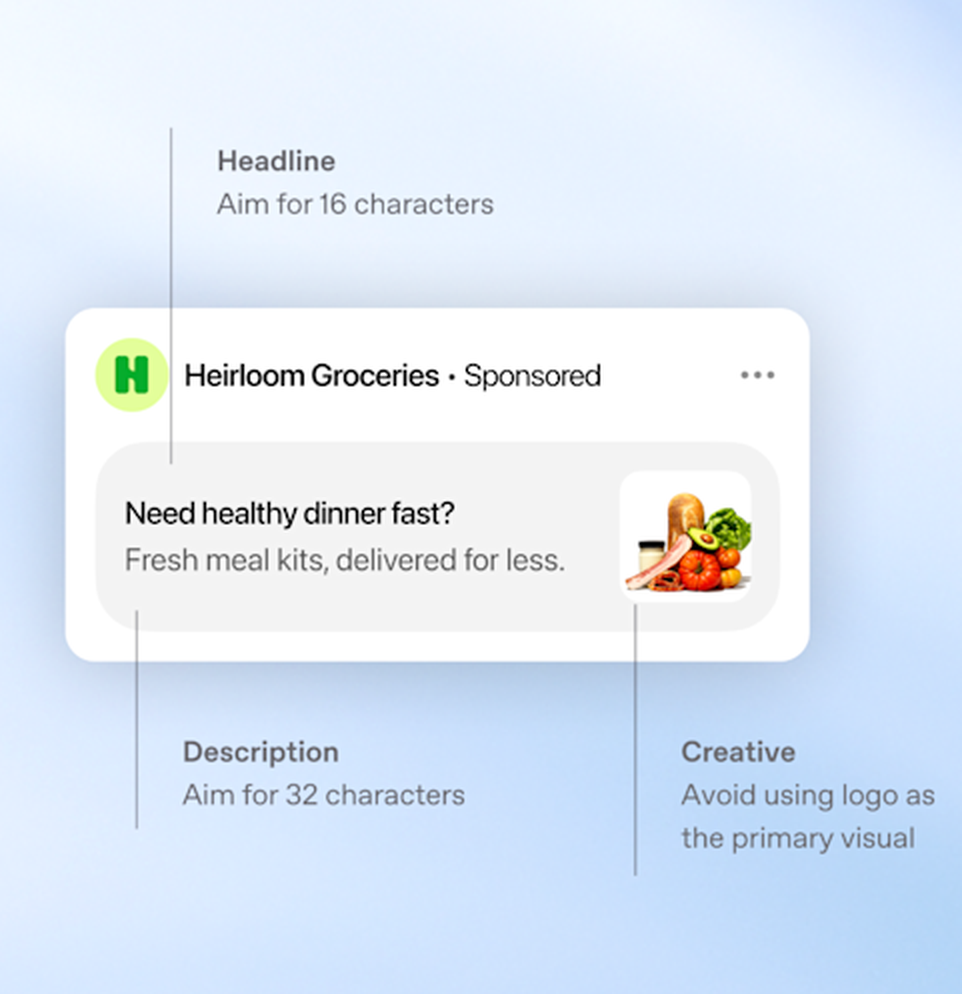
OpenAI asks for roughly 16 characters of headline and 32 of description, plus an image — and advises against using your logo as the primary visual.
That is short. Short enough that a slogan won’t fit and a plain offer will. It works the same way in any sector:
Leak fixed today — Licensed plumbers, same-day. (16 / 28)
A weekend away — Coastal golf, spa and dining. (14 / 29)
Close books faster — Month-end in two days, not ten. (18 / 31)
None of those are clever. All of them say what happens if you click. At this length that is the whole craft.
What we’d actually do
We would not move meaningful budget off Google or Meta. The platform is new, the eligible audience is narrower, and there is no performance history to compare against.
We would run a controlled test, instrumented properly:
- The OpenAI Pixel on the site, plus the server-side Conversions API, with the same event ID on both so browser and server events don’t double-count
- Three or four intent groups rather than one catch-all campaign
- Conversion-optimised bidding against a real business event — a lead, a booking, an order — never impressions
- Two to three weeks, incremental budget, results sitting beside Google and Meta so the comparison is cost per outcome rather than cost per click
For most businesses that is three or four campaigns at C$40 to C$75 a day. It buys an answer, which is the only thing worth buying from a channel this young.
What we can’t tell you yet
Three things, because the internet is already confident about all of them.
Sub-country targeting. OpenAI documents state, DMA and ZIP targeting for the United States, and says availability varies by country. Elsewhere, check the live interface before you promise a service-area business that you can fence their footprint. We have seen guides assert both country-only and postal-code targeting for Canada; they can’t both be right.
Budget pacing. A 2× daily / 7× weekly rule is circulating widely. We could not find it in OpenAI’s documentation. Treat the daily figure as a target and watch the first week’s delivery against the invoice.
Attribution lag. Same status — a 24 to 48 hour figure appears in third-party guides and not in the docs. Build your reporting to restate the trailing week rather than hard-coding a number.
We would rather say “we don’t know yet” three times than quote a figure we can’t source.
The actual question
Not whether ChatGPT advertising works. Whether it acquires customers at a cost that competes with the channels you already run.
That is answerable in about three weeks for roughly the price of a week of Google. If the answer is no, you learned it cheaply. If it’s yes, you have performance data on a significant new channel before most advertisers have worked out what it is.
Sources, all read 11 August 2026: Ads in ChatGPT: the basics, Ads in ChatGPT, Ads Manager availability.